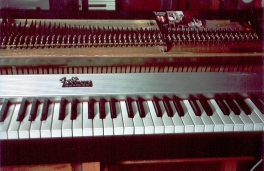
Close up of a Fender Rhodes, restored at our Mercia workshops. 73 Stage model, MK2 action (plastic hammer shafts, wooden heads & neoprene tips), with full skirt keys. Harp cover is removed, showing the resonator bars.
Created in the 1950s by Harold Rhodes, the Rhodes piano embodies the tuning fork principle.
Various instruments using this principle were built in Victorian times.
The sound of these, though mellow, is weak, suitable only for small drawing rooms etc. |
|
Harold Rhodes ingenuously devised an asymmetric variant on the basic idea. This has a number of advantages. Most of the vibrating amplitude is concentrated in one tunable slender wand or tine. The other arm of the fork is more rigid, facilitating an easily adjustable method of mounting. Since it vibrates less, its pitch is not so critical. Over most of the range, only the tine requires provision for adjustment.
The tine is removable, for easy replacement. This is needed, the high vibrating amplitude makes breakage common with heavy playing. A system of pickups is used, requiring no sound board. Volume is thus limited only by amplifier power available. For recording, a direct connection is possible, avoiding ambient noise & problem acoustics.
This instrument deservedly took the music world by storm, becoming almost as ubiquitous as the Hammond organ. Its mellow, laid back tone & distinctive strike harmonics have been heard on many milestone records over the years. Popularity for many types of music is undiminished.
Lighter than the Hammond, it is easily carried, although it helps to have The Incredible Hulk as a friend. Weight of the 88 key Stage model is 66 Kilos, less for the 73. The 54 key version is not so popular although, being more lightly built, it can be carried by one person.

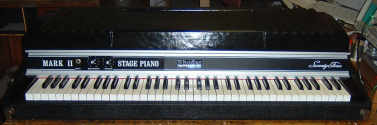 The Rhodes Mark II Stage Piano,
 this is basically similar to the Rhodes Mark One (not the Fender Rhodes Mark One). What we call the MK3 action, lighter all plastic hammers with neoprene tips, aluminium action frame, steel pinned wooden keybed.
This 73, restored in our workshops, has a Pratt Read keyboard, with one piece moulded key caps.
The main differences between the Mark I & Mark II Stage models are cosmetic, the harp cover is flat with ribs, in place of the popular 'round top'. This enables another keyboard to be stacked on top, unfortunately this often results in unsightly scratches. If possible, choose one without these, unless it is otherwise worse. Later versions have a large projecting top lip on the control panel, an improvement over using the keyboard as a holder for burning cigarettes.
Mark II Suitcase models, on the other hand, are quite different electronically, less desirable & not so sought after. Action is unchanged, but the pre-amp uses LEDs & integrated circuits to provide the stereo tremolo. The result is that much of the beauty of the effect is lost, it sounds more like 'auto-pan' as provided on some effects units.
The earlier germanium transistored power amplifier became silicon & with slightly higher power. This gives a 'harder' sound & the greater output & gain causes a tendency to acoustic feedback. Still a good piano, just not so good as the earlier version.
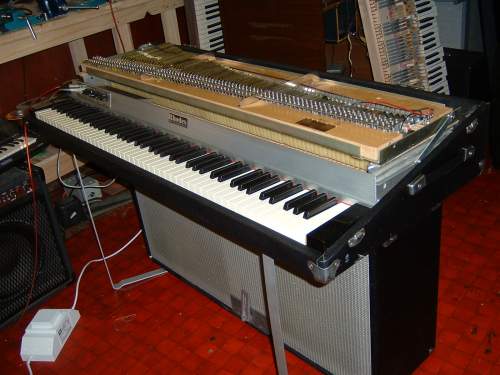
The famous
Stereo Suitcase models have a second cabinet with four 12 inch speakers & two 40 Watt amplifiers. This forms a base for the keyboard, in place of the Stage model's legs.
Shown here is a 115 Volt Rhodes (MK3 action) Suitcase 88 model being restored at our Mercia facility.
The original monophonic tremolo became Stereophonic, after the first version, the makers call it 'Vibrato'. This switches the signal from one pair of speakers to the other in 'ping pong' manner, the result is surprisingly effective.
Bill Dunne, much more than just a good service man, had some time previously applied for a British patent for this idea, to simulate the Doppler effect for organ use. During early development he found that it was not convincing in that role and did not continue. He also did not pursue the matter of possible patent infringement.
Later (Mark II) versions use an 'updated' pre-amplifier, with five pin coupling lead, integrated circuits & slide controls. The tremolo is not as good, older models are more sought after.
Over the years a number of devices have been made to add ping pong tremolo to the Stage models, some are good. Some effects units have an 'auto pan' feature, although similiar in principle, these do not sound the same. All is not lost however, see elsewhere on this site.
Amplification.
A common question we are asked is "what is the best type of amplifier for a Rhodes Piano". As with many such questions there is no definitive answer, but an amplifier must satisfy a number of requirements. It must be able to handle the wide frequency range of a keyboard instrument, especially with the 88 models.
It should also be able to handle the pure, sine wave like, sound without distortion. At least up to sufficient volume for the situation. Some well known amplifiers can do the job, many more can't.
Starting with valves (tubes): The Fender Twin Reverb is often suggested as the ideal amplifier. It certainly is reasonably loud & clean, but falls short at the bass end. Its open back design causes phase cancellation at lower frequencies, it is designed for lead guitar.
It does have two twelve inch speakers & one hundred Watts of output. This is the best specification for the instrument, many players find the Twin suits them just fine. To handle bass a closed or reflex twin enclosure is better. A bass guitar cabinet for example, not with most standard 15 inch speakers though, these can't reproduce treble.
A clue can be gathered from the suitcase model, a ported design with four 12 inch speakers, driven by two forty or fifty Watt amplifiers. It is difficult to better this. Twelve inch cones are light and stiff enough to handle the highest note. Four have enough area to move plenty of air for the bottom end. So a 4 by 12 or two 2 by 12s are near to ideal.
I tune & initially set up pianos using two Tannoy Monitor Red cabinets. Single fifteen inch speakers, with a co-axial treble horn driver sharing the same magnet. Each enclosure is an eight cubic foot bass reflex. When a suitcase top is then connected to its own cabinet, the treble is actually louder, bass is only marginally down.
This is because the 12 inch speakers are not 'High Fi', they are optimised to suit the piano. They do not need a response going far beyond the top note. Speakers designed for full range guitar are also usually suitable.
We tried a sealed Marshall 4 X 12" cabinet, which was rather 'boxy' sounding (insufficient cabinet volume for the total cone area). Marshall amplifiers are not usually ideal, they are designed for guitar & easily driven into distortion.
The Roland Jazz Chorus-120 (JC-120) works well & sounds good. Its acoustic chorus is effective with the piano sound. Again it is open backed, so the bass end is weak. The JC-160 version is better still, having a bit more power. Both are reliable.
As for dedicated 'keyboard' amplifiers, it is best to try these before deciding to buy. Most are designed for synthesisers and similar instruments. Ideal for voices witth a strong harmonic content & may not suit the fairly pure Rhodes sound.
To be continued...
Servicing, tuning, restoration etc.
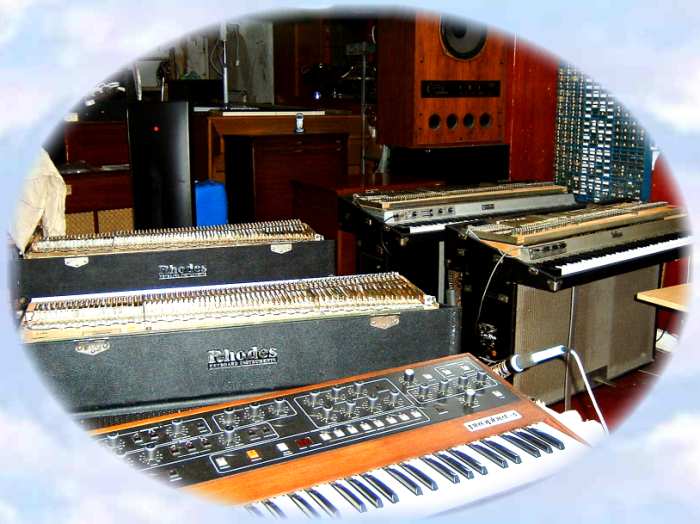
Rhodes & Fender Rhodes servicing, tuning and restoration. A typical day in our workshops, servicing
4 Rhodes Suitcase 73s, of various ages.
Work is done according to the instrument's condtion and owner's requirements. From a basic tune & setup to a full restoration.
Snake oil cures. We do not believe in most remedies & modifications sold in packs or kits. Such as "pedestal mod kits" etc. Harold Rhodes & his team knew how to design and build pianos. They did it for a long time, If their original design was wrong, these instruments would no longer be in use.
The way to get the best from any particular instrument, is to set it up as the designer intended, commonly called 'blueprinting'.
Safety.
The Stage Piano is not powered & has no integral safety issues. Mains safety is set by the amplification equipment etc. it is used with.
The Suitcase Piano, in original condition, has a three conductor American mains connector & includes an earth connection.
Safety rating: '2'. It will drop to '0' if some-one has broken off the earth pin, which is often the case. Ideally the connector should be changed to an earthed IEC type, but only for 230 Volt models. Such connectors, fitted to 115 Volt instruments, may get connected to 230 Volts
(bang).
Evolution in Design etc.
From the first model the design evolved, some changes were small improvements and some greater. All types remained true to the original concept, as do the new models being produced now.
Common features: Wooden (except for MK4) balnced keys, 'tone generator' assemblies with a slender tine fitted in a steel block, mounted on a more massive support leg, which I call a 'resonator'. The two form a fork, the heavier leg vibrates less and acts as a mounting. The tine's tip is close to a magnetic rod wound with a coil, which acts as a pickup. The tine assembles are mounted above the keyboard.
A hammer rests on top of the rear extension of each key and is launched upwards when that key is struck. The hammer in turn puls down a damper, away from the tine, which it then strikes.
Originally the hammers were wooden, resembling those of a string piano. In other ways the design is quite different, for example there is no escapement mechanism. These differences, present on all models, show in the feel of the keyboard and the playing style that suits it.
I give the major mechanical variants an 'MK' number for convenience, this is not the same as the company's 'Mark X' title on various models. The MK1 used hammers as mentioned above, a slender wooden rod, with a felt clad 'teardrop' head. Resonators are solid steel bars about half an inch square, longer than the tines as no tuning weight is used. Each bar extends past the tine securing point, to form a mounting for the assembly, this end is nearest the player.
The longer bass end resonators are cut away on the underside, to clear the vibrating tip of the tine. This also lowers the tuned frequency, allowing them to be shorter than otherwise. Dampers are beneath the tines, mounted near the back of the action. 'Bridle straps' attach each of them to the rear of its associated hammer shaft. so it is pulled down, away from the tine, as the hammer rises.
The MK2 is a radical redesign...
More shortly...
|
Onwards, the New Rhodes.
Although the Rhodes Keyboard Instruments name survived a number of takeovers, the great man behind these marvels is unfortunately no longer with us. The trademark again came under new, this time benevolent, ownership. It will be interesting to see what the future holds, we hope it is bright, our belief in modern electro-mechanical instruments is well known.
A new Rhodes Music Corporation was formed. Nine new prototype MK7 models were exhibited & demonstrated at the 2007 NAMM show. Including a concert in tribute to Harold Rhodes. Production was planned to start in the autumn (fall) that year. Sales were later expected to begin in early 2008. Shipping has now started.
The action is based on further development of the Mark V, considered to be the most 'sorted' production version of the original design, with better dynamics & damper operation. It just came out too late, when the company was already in trouble.
We wish the Rhodes Music Corporation success in their venture, we hope that they attact enough customers to fulfill their aim of keeping Harold's dream alive. Our 'Links' page includes a text link to the very interesting company Web site, this text also links to them, the 'back' button will return you here. We will be happy to provide a feature on the new pianos, once they start coming over to our side of the Pond.
They are keen to start selling in Britain, I hope this can begin soon. There are plenty of players over here looking for good Rhodes pianos. The new range includes passive (S) models, equivalent to the old Stage version, active (A) models, with stereo tremolo & active (AM) models which include MIDI, their site will tell you more. Available in three colours, black, red & pearl white. Sizes are 88 key, 73 key and 61 key.
A colour matched stereo speaker cabinet is also available, allowing a setup like the original Stereo Suitcase model, with modern class D amplifiers.
|
Dulcitone. An 1897 oak cased model. Courtesy of Whittaker's Museum, Waiheke Island. Link to their site.
The most successful of the early tuning fork instruments.
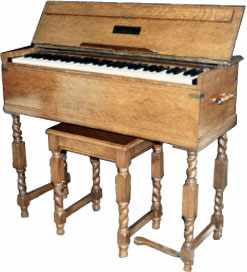
The Dulcitone was designed in 1860 by Thomas Machell & Sons of Glasgow. As far as I know it remained in production until the 1920s. My experience of this instrument was in the early 1960s, when I overhauled one for a friend.
It is a light portable keyboard instrument, usually 5 octave, with folding legs. Uses a downstriking form of the English grand piano action, with single escapement. The key front pushes this mechanism down.
The tone source is a set of U shaped steel bars, using the tuning fork principle. Giving a mellow tone & good sustain. Originally held by leather straps, spring steel was used later. Struck by traditional felt dressed hammers.
A solid harp frame is not needed, reducing weight. On older models, tone bars tend to fall out of place in transit, solved by a simple mechanism. A pedal pulls a cord, wrapped round a rotating, sprung wooden rod. This is set with a row of thin steel tines, which 'comb' the tone bars into position. The spirit of Heath Robinson was alive & well.
Later models, with spring mounted tone bars, use this pedal to control a damper mechanism.
Features from this instrument survive it. The tuning fork principle is used, in modified form, for the Rhodes piano, created 90 years later. The inverted front action allows a compact layout, as in the Hohner Clavinet, a slender amplified clavichord, of Stevie Wonder fame. Most electronic keyboard instruments use a similar arrangement.
|
All LOGOs, Brand & Model names are Trademarks and/or Copyright of their respective owners.
The Rhodes name & logo are trademarks of their owners. This site is not affiliated with the Rhodes family, the Rhodes Piano Corporation, any other current or former owners of the trademarks. The same applies to the Fender name & logo.
All opinions in this section are those of the author, Ron Lebar.
Information given is generally brief & is based on our experience. If you spot any factual mistakes or 'typos' please feel free to let us know. We are not quite perfect & promise not to sulk over constructive criticism.
If you need more information on models listed or can suggest another instrument to add let us know & we will do our best. From time to time we may include comprehensive details of specific models.
Visit  pages for more information. pages for more information.
For Service & Repairs etc. call: +44 (0)207 288 0037
E-Mail us for hire, repairs, orders etc.
Service <  > Hire > Hire
Classic & Modern Instruments or Equipment. Stage, Studio & Broadcast |
Rhodes. Edited: 29-10-2016. © Ron Lebar, Author.
 ©
©